
Fraudsters in the online gambling space use many of the same tactics documented in broader cryptocurrency fraud — fake credentials, withdrawal manipulation, phishing-style bonus traps, and identity theft through unverified KYC collection. For Canadian players who have taken the time to learn about cryptocurrency security, applying that same critical mindset to crypto casino selection is both practical and necessary.
This guide covers the specific security red flags, verification steps, and operational practices that distinguish trustworthy crypto casino operators from fraudulent or poorly-run ones. It is structured the same way any good cryptocurrency security practice is structured: understand the threat, know what to verify, take the right precautions, and use reliable resources.
Why Crypto Casinos Attract Fraud Risk
The intersection of cryptocurrency and online gambling creates a specific fraud environment for several reasons.
Cryptocurrency transactions are irreversible. Unlike a credit card payment that can be disputed and reversed, a blockchain transfer cannot be recalled once confirmed. A fraudulent platform that accepts a deposit and then manipulates withdrawals or simply disappears has received funds that cannot be clawed back through the blockchain itself.
Most crypto casinos are offshore operators. They sit outside Canadian provincial regulatory frameworks — which means there is no equivalent of a bank regulatory authority to report fraud to, no mandatory deposit insurance, and no provincial body with enforcement authority over the platform. This is not inherently dangerous, but it means the fraud prevention work that regulators perform in licensed domestic markets falls to the player instead.
High bonus offers are a documented fraud vector. In the broader crypto fraud landscape, promises of extraordinary returns are a primary scam mechanism. In crypto casinos, oversized welcome bonuses with exploitative terms serve a similar function: they attract deposits, create obligations that make withdrawal nearly impossible, and generate revenue for the platform from players who can never clear their bonus to a withdrawable state. Understanding how bonus fraud works in this context protects players from what is effectively a legal but exploitative scam.
Step 1: Verify the Licence — Do Not Accept the Claim Alone
The most basic security check before depositing at any crypto casino is licence verification. The principle is identical to any other digital trust verification: do not accept a stated credential at face value; confirm it against the issuing authority’s public record.
The two most common licensing jurisdictions for offshore crypto casinos are the Curaçao Gaming Board (GCB) and the Kahnawake Gaming Commission (KGC). Both maintain searchable public registries.
The Curaçao GCB has issued licences since 1993. A legitimate Curaçao-licensed casino will display its licence number, typically in the footer of its website. That number can be cross-referenced against the GCB’s publicly accessible registry. An operator that claims a Curaçao licence but provides no verifiable registration number is making a claim that cannot be confirmed — treat it as unverified.
The Kahnawake Gaming Commission publishes its list of licensed operators publicly. The same principle applies: a licence claim without a verifiable number is not evidence of licensing.
Red flags to watch for:
Licence number is absent from the website entirely
Licence number is present but returns no match in the issuing authority’s registry
Platform claims a licence from a jurisdiction that does not operate a searchable public registry
Platform claims multiple licences but only one is verifiable
For Canadian players in Ontario specifically: the AGCO (Alcohol and Gaming Commission of Ontario) maintains a public registry of operators registered for Ontario’s iGaming market. Any casino that claims AGCO registration can be verified directly at the AGCO’s site. Most crypto casinos are not registered there — which is not inherently fraudulent, but it means Ontario players have no provincial consumer protection framework if a dispute arises.
Step 2: Read the Complaint Record, Not Just the Review Score
Aggregated star ratings on review platforms are easily gamed. A fraudulent or poorly-run platform can accumulate positive reviews through incentivized submissions, fake accounts, or simply by providing a positive experience for small deposits while manipulating large withdrawals.
The complaint record is harder to fake and more revealing. Specifically, the pattern of complaints matters more than their number.
The most important fraud signal in the crypto casino space is complaints about large withdrawal delays or denials that do not appear in complaints about small withdrawals. This pattern — fast payments on small amounts, delays and disputes on large ones — is a classic fraud mechanism. The platform accepts deposits freely, processes small withdrawals to maintain a positive surface reputation, and then delays, disputes, or demands excessive documentation when a player attempts to withdraw a significant win.
Other complaint patterns worth screening for:
KYC documentation requested immediately before a large withdrawal, after months of play with no prior request
Bonus terms being altered retroactively, or terms being interpreted differently at withdrawal than at signup
Account closures coinciding with large pending withdrawals, with funds withheld on vague “suspicious activity” grounds
Customer support that is responsive before deposit and unresponsive after a withdrawal is requested
The most reliable complaint sources are community forums where players document experiences in detail, complaint databases that track patterns across multiple players for the same operator, and casino watchdog sites that investigate complaints with documented evidence rather than anonymous assertions. A platform with years of operation and no consistent complaint patterns in any of these sources has a meaningfully cleaner record than one that has only existed for six months.
Step 3: Understand Bonus Terms as a Security Document
The welcome bonus is the primary mechanism through which many crypto casinos create exploitative conditions for players. From a security perspective, the bonus terms should be treated as a legal document, not marketing material — because they are what determines whether you can access your funds.
The key clauses to verify before claiming any bonus:
Wagering requirement and what it applies to. The wagering multiplier tells you how many times you must wager before bonus funds can be withdrawn. Critically, what the multiplier applies to matters enormously. A 35x requirement on bonus funds only is a very different obligation from a 40x requirement on deposit plus bonus combined. A player who deposits C$100 and receives a C$100 bonus at 40x deposit-plus-bonus must wager C$8,000 before withdrawing, compared to C$3,500 for 35x on bonus only.
Maximum bet during wagering. Most reputable platforms set a maximum bet of C$2 to C$5 per spin while bonus funds are active. Platforms that fail to state a maximum bet clearly, or that set unrealistically low limits not disclosed at signup, are creating conditions for retroactive bonus cancellation — a documented fraud pattern where a platform voids a bonus on the grounds that the player “violated terms” that were not prominently disclosed.
Game contribution rates. Most bonus terms specify that only certain games contribute fully toward wagering requirements. Slots typically contribute 100%; live dealer games and table games often contribute 5% to 10% or nothing at all. A player who bets primarily on blackjack may discover after hundreds of sessions that almost none of their wagers counted toward clearing the bonus.
Expiry windows. Some platforms set extremely short bonus expiry windows — 24 to 72 hours — that make clearing the requirement functionally impossible for recreational players. Tight expiry windows are a mechanism for allowing the platform to cancel bonus obligations while retaining the deposit.
Withdrawal restrictions while bonus is active. Many platforms prohibit withdrawal of any funds, including the original deposit, while a bonus is active and uncleared. A player who claims a bonus and then decides they want to withdraw their deposit must often forfeit the bonus first — effectively trapped until the wagering is complete or the bonus expires.
The practical security rule: read the full bonus terms document before claiming. If any of the above clauses are absent, vague, or appear to conflict with the marketing description, treat the bonus as a liability rather than a benefit. Depositing without claiming a bonus and playing with deposit funds only is always an option, and for players who cannot commit the time to clear wagering requirements, it is often the better one.
Step 4: Assess KYC Practices Before Depositing
KYC (Know Your Customer) processes at crypto casinos are both a legitimate compliance requirement and a documented fraud vector. Understanding which is which before you deposit protects against both identity theft and withdrawal manipulation.
Legitimate KYC involves verifying a player’s identity to comply with AML (Anti-Money Laundering) regulations. Reputable platforms disclose their KYC thresholds before signup — stating clearly at what withdrawal amount or cumulative win level documentation is required. The documents requested are standard: government-issued photo ID, proof of address, and sometimes source-of-funds documentation for large withdrawals.
KYC as a withdrawal manipulation mechanism looks different. The distinguishing features are: KYC requirements triggered specifically when a large withdrawal is pending (not as a routine process), requests for documents beyond what is standard (such as demanding bank statements, tax records, or documents not relevant to identity verification), and indefinite processing timelines that effectively freeze funds indefinitely without formal denial.
If a platform requests KYC documentation only after you attempt a large withdrawal, and that request was not disclosed in the terms at signup, be cautious. Legitimate platforms document their KYC process before you deposit, not in response to a specific withdrawal attempt.
For crypto-specific identity protection: never submit identity documents through an unencrypted form or email. Verify that the platform’s KYC portal uses HTTPS and that the domain matches the casino’s official registered domain exactly — phishing subdomains that mimic legitimate casino KYC pages are a documented fraud method.
Step 5: Use a Verified Comparison Resource First
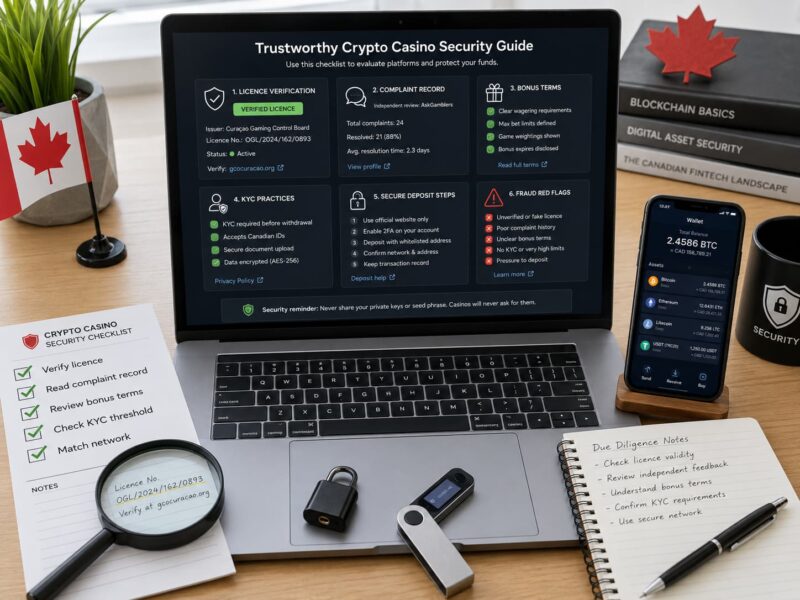
Applying security-level scrutiny to 23 different crypto casino operators before deciding where to deposit is a significant time investment. A reliable Canadian-specific comparison resource that has already done this work is the more efficient starting point.
Best Crypto Casino Canada has evaluated 23 operators specifically for Canadian players, with methodology that mirrors the security checks described in this guide: licence verifiability, payout speed from community reporting rather than platform claims, real bonus terms after wagering (not headline numbers), KYC thresholds in practice, and provincial access by regulation. Critically, it includes operators it explicitly recommends against — with documented reasons based on complaint patterns — alongside those it recommends. A comparison resource that only shows its best placements is not performing a security function; one that identifies bad actors is.
The guides section covers the Canadian deposit path (the Interac-to-exchange-to-casino route), the provincial regulatory landscape post-2026, and the CRA tax position on crypto casino winnings. For players who want to understand the full security surface of the Canadian crypto casino space before making any platform decision, this resource covers the relevant ground.
Recommended Platforms for Canadian Players: Security-Verified
Based on the verification criteria above, the following platforms have the cleanest security profiles for Canadian players in 2026:
7Bit Casino (Curaçao GCB licensed, operational since 2014): Long operational history, thin complaint file relative to scale, verifiable licence, community-reported withdrawals averaging eight minutes. Bonus terms (35x on bonus funds only, C$2 max bet) are disclosed clearly. CAD-native cashier removes conversion step.
BitStarz (Curaçao licensed, operational since 2014): Terms explicitly state no Canadian player restrictions — verifiable in the full terms document. Hybrid cashier (Interac + crypto) is unusual and indicates a legitimate, well-resourced operation rather than a quick-launch platform. Payouts average nine to eleven minutes in community reports.
wild.io (Curaçao licensed): Fastest independently tested payout times in the current Canadian comparison field — around six minutes. KYC is threshold-based and functionally not triggered below approximately C$1,000 in community reports. Bonus terms (40x, one-day expiry) are strict and should be read carefully before claiming.
Cloudbet (Curaçao licensed, operational since 2013): Among the longest track records of any crypto casino. Tiered KYC structure is disclosed before signup. One documented large-withdrawal review delay exists in community records — relevant for high-stakes players.
JackpotCity (AGCO-registered for Ontario): The only option in the comparison with provincial consumer protection in Ontario. The AGCO registration is publicly verifiable in the Ontario iGaming registry. Ontario’s regulated framework prohibits cryptocurrency within licensed operations; this platform operates on Interac and card rails for Ontario players.
Security Practices for Crypto Casino Deposits
Regardless of which platform you choose, the following operational security practices apply.
Use a dedicated wallet address for casino activity. Never send from an exchange account or from a wallet that holds long-term holdings. A casino-specific wallet address keeps your activity isolated and your records clean.
Verify the deposit address on every transaction. Copy-paste malware that replaces clipboard addresses is a documented cryptocurrency fraud vector. After pasting a deposit address, verify that the first and last several characters of the address match what the casino cashier displays before confirming the transaction.
Match the network exactly. Sending USDT on ERC-20 to a TRC-20 address results in permanent loss of funds. The network label in your wallet must match the network label in the casino cashier. This is one of the most common and irreversible mistakes in crypto transactions.
Screenshot your bonus terms at signup. If a platform attempts to alter or interpret your bonus terms differently at withdrawal time, a timestamp screenshot of the terms at the moment you claimed is your documentation.
Set deposit limits before your first session. Every legitimate platform offers deposit limit tools. Configure them before depositing. A platform that makes deposit limits difficult to find or set is signaling something meaningful about its relationship with responsible gambling.
Report suspected fraud. If you experience a withdrawal refusal, funds freeze, or document request that appears to be manipulative rather than compliance-based, document everything and report to the platform’s licensor (Curaçao GCB or Kahnawake GC as appropriate), to the Canadian Anti-Fraud Centre, and to relevant consumer protection communities. Even if the funds are not recovered, documented complaints create the pattern record that protects other players.
Summary
Crypto casino fraud follows the same patterns as broader cryptocurrency fraud: false credentials, manipulative terms that prevent access to funds, identity exploitation through document collection, and exploitative reversible-only-by-the-operator mechanisms. The defenses are also the same: verify credentials independently, read the terms document rather than the marketing, understand the KYC process before submitting documents, and use verified resources rather than platform-provided claims.
The Canadian crypto casino market in 2026 has trustworthy options. Finding them requires applying the same investigative discipline that good cryptocurrency security practice requires in every other context. Best Crypto Casino Canada provides the platform-level verification layer; this guide provides the security framework for interpreting it.
[For more on cryptocurrency fraud prevention, digital asset security, and protecting your holdings online, explore the courses and articles available on this site.]
Disclaimer: Gambling involves financial risk and is for adults of legal age — 19+ in most Canadian provinces, 18+ in Alberta, Manitoba, and Quebec. Most crypto casinos are offshore operators without provincial consumer protection registration. Ontario’s AGCO-regulated market prohibits cryptocurrency in licensed operations. This article is for educational purposes and does not constitute financial or legal advice. If you have experienced crypto fraud: report to the Canadian Anti-Fraud Centre at antifraudcentre-centreantifraude.ca or call 1-888-495-8501. For responsible gambling support: ConnexOntario 1-866-531-2600 or responsiblegambling.org.
About the author: Written by a cryptocurrency security and digital finance writer with a focus on fraud prevention, platform verification, and Canadian crypto consumer protection.